The Ultimate Vendor Selection Strategy: How to Source Industrial Equipment Effectively
As the global industrial landscape faces unprecedented shifts in logistics and technology, the procurement of modern material handling equipment has transformed from a back-office administrative task into a critical strategic function. Today, your choice of vendor is not merely about acquiring hardware; it is about selecting an innovation partner capable of navigating complex supply chain environments. If your organization relies on legacy procurement habits, you are likely leaving hidden costs on the table while exposing your operations to unnecessary risks.
Shifting from Transactional Buying to Strategic Sourcing
The Evolution of Industrial Procurement in a Post-Pandemic World
The post-pandemic era has dismantled the traditional lean procurement model. Once, “just-in-time” delivery was the gold standard; today, it is often viewed as a structural liability. Manufacturing supply chains are now defined by their ability to withstand volatility. Procurement leaders must pivot from prioritizing the lowest acquisition cost to optimizing for resilience, flexibility, and long-term serviceability. The modern industrial buyer must evaluate how a machine integrates into the broader ecosystem, rather than viewing it as an isolated unit.
Why the “Lowest Bid” Strategy Fails in Modern Manufacturing
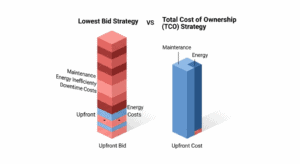
Comparing the Total Cost of Ownership (TCO) against the traditional ‘Lowest Bid’ approach reveals how higher upfront investments often lead to significant long-term savings.
The “lowest bid” approach is a procurement death trap. While a lower sticker price offers immediate relief to an annual budget, it frequently masks significant long-term expenses in maintenance, energy inefficiency, and technical incompatibility. When you source based solely on cost, you lose leverage. You are treated as a customer of a commodity rather than a partner in an innovation cycle. The most successful firms now prioritize the “Total Cost of Ownership,” recognizing that a slightly higher upfront investment often yields exponential savings in uptime and output performance.
Defining Your Core Operational Requirements
Identifying the Performance Gap: Problem vs. Solution
Before reviewing any catalog, you must clearly define the specific performance gap you need to bridge. Are you trying to solve a bottleneck in your existing automation flow, or are you scaling to meet new market demand? A clear definition of the problem prevents the mistake of over-engineering your solutions. Focus on the core obstacle—the specific “problem” your operations team faces daily—and prioritize vendors who offer specialized expertise for bespoke material handling solutions in that exact niche rather than those offering a broad, one-size-fits-all product portfolio.
Technical Specifications vs. Desired Business Outcomes
Technical specs are vital, but business outcomes are the true north. Do not ask for a machine that runs at a specific speed; ask for a machine that meets your production targets while maintaining your energy efficiency standards. By framing your RFP (Request for Proposal) around desired business outcomes, you allow manufacturers (OEMs) to provide more creative and efficient options. This shift moves the conversation from “what does this cost” to “how does this improve our bottom line.”
Future-Proofing: Scalability and Industry 4.0 Integration
Industrial equipment has a lifespan measured in decades. Your selection process must account for the rapid pace of Industry 4.0. Will the machine you purchase today be compatible with the IoT sensors and data analytics platforms you plan to deploy in five years? Ensure your vendors provide hardware that is modular and upgradeable, as this prevents your new assets from becoming expensive “islands” of outdated technology within your factory floor.
The Sourcing Matrix: Choosing the Right Procurement Channel
Working Directly with Original Equipment Manufacturers (OEMs)
Engaging directly with OEMs provides unmatched technical depth and early access to product roadmaps. This route is ideal for highly specialized equipment where internal engineering support is required for long-term optimization. However, be aware that OEMs may lack the agility of smaller distributors when it comes to regional service response times.
The Role of Industrial Distributors and System Integrators
System integrators serve as the bridge between disparate technologies. If your project involves complex automation, an integrator is essential to ensure that your new equipment communicates seamlessly with legacy systems. They provide the “glue” that keeps manufacturing supply chains fluid. While you may pay a premium for their expertise, the reduced risk of integration failures often justifies the cost.
Navigating the “Channel Dilemma”: Service Speed vs. Technical Depth
You must balance technical depth with the speed of service. If a critical machine fails, do you need an engineer from the OEM flying in from across the globe, or a local service technician from a distributor who can arrive in two hours? Your choice of channel should align with your tolerance for downtime.
Conducting a Supply Chain Resilience Audit
Assessing the Vendor’s Supply Base and Material Scarcity Risks
Request detailed information about your vendor’s supply chain. Where do their critical components originate? If a vendor relies heavily on a single region prone to geopolitical instability or labor shortages, your operation is inherently at risk. A resilient vendor will have diversified their material sources and maintain strategic inventory buffers for critical parts.
The Move Toward Nearshoring and Regional Supply Chain Stability
Prioritize vendors who have embraced regionalized supply chain management. Nearshoring is no longer a trend; it is a risk mitigation strategy. A vendor that manufactures or stocks spares regionally can provide a level of responsive support that global-only competitors simply cannot match.
Evaluating Lead Times and Production Capacity Realism
Be wary of “optimistic” lead times. During the vetting process, ask for historical data on their on-time delivery performance. A vendor that promises the impossible is often a vendor that will fail when systemic pressure increases. Seek transparency regarding their current manufacturing capacity and their backlog.
Beyond the Sticker Price: Analyzing Total Cost of Ownership (TCO)
Calculating Integration and Installation Costs
The price on the quote is rarely the final price. You must account for the infrastructure upgrades, software licenses, and specialized labour required for installation. A cheaper machine that requires extensive factory modifications is almost always more expensive than a premium unit that is “plug-and-play.”
Factoring in Energy Consumption and Operational Efficiency
Energy is often the largest recurring operational expense for industrial equipment. Evaluate the power requirements of the machine over a five-to-ten-year horizon. Even a marginal improvement in efficiency can translate into significant cost savings, directly impacting your margin per unit.
The Real Cost of Downtime: Maintenance and Spare Parts Availability
Downtime is the silent killer of productivity. When evaluating a vendor, treat their spare parts infrastructure as a core technical component. Ask: What is the availability of common wear items? Is there a local warehouse, or must parts be air-freighted? A robust after-sales ecosystem is worth a higher initial investment. Additionally, ask about pre-purchasing essential spare parts in the original quote.
Evaluating Technical Support and the “After-Sales” Ecosystem

Assessing the Support Team’s Responsiveness and Expertise
“Service as Revenue” is a growing trend. Leading manufacturers, such as those in the semiconductor space, generate billions through service contracts because they understand that support is the product. Test your prospective vendor: send a mock support request during the vetting phase. How quickly do they respond? Do they provide direct access to engineers, or are you routed through an automated help desk?
The Criticality of Comprehensive Training Programs for Operators
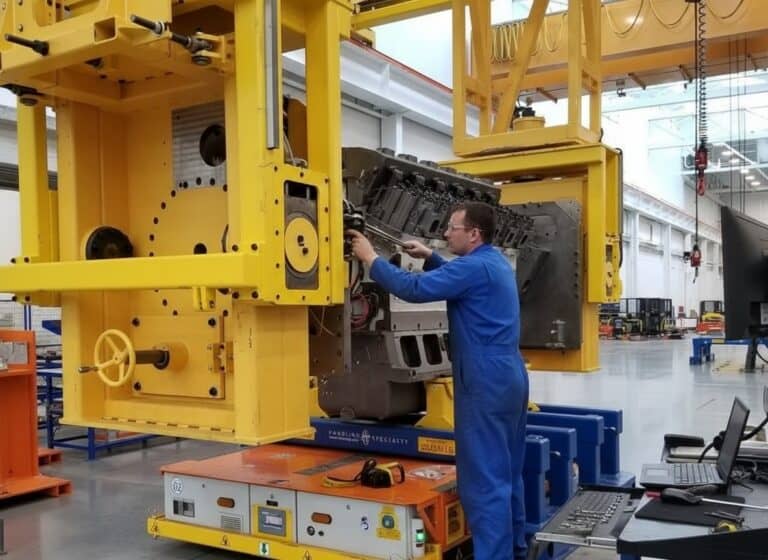
Equipment is only as effective as the people running it. Evaluate the vendor’s training offerings. Do they provide on-site, hands-on training, or just digital manuals? A vendor like Handling Specialty, that invests in your team’s competency is a vendor that is committed to your long-term success.
Remote Diagnostics and Digital Support Capabilities
In the age of Industry 4.0, physical presence is not always required for technical assistance. Does the vendor offer remote diagnostics? Can their team securely tunnel into your machine to troubleshoot software glitches? These digital capabilities significantly reduce the mean time to repair (MTTR) and represent the future of industrial maintenance.
Technical Vetting: Automation and Interoperability
Data Analytics and Software Compatibility
Ensure the vendor’s equipment provides open-protocol data output. If the machine stores data in a proprietary, locked format, you are effectively tethered to that vendor for life. Prioritize interoperability and seamless API integration to ensure your data flows smoothly into your ERP or MES systems.
Ensuring Compliance with Certification and Safety Standards
Never compromise on safety standards. Beyond regulatory requirements, evaluate the machine’s built-in fail-safes. Does the vendor have a clear roadmap for keeping their equipment compliant with evolving industrial standards? A vendor that falls behind on compliance creates a legal and operational nightmare for your firm.
Evaluating User Experience (UX) and Worker Safety Features
Worker safety is a business imperative. An interface that is confusing or poorly designed leads to operator error and accidents. Review the UX of the machine control panels. Is the system intuitive? Does it minimize the cognitive load on the operator? A safer, more ergonomic machine will naturally experience higher adoption rates and better performance from your workforce.
The Human Element: Cultural Fit and Long-Term Partnership
Communication Transparency During the Sales Cycle
The sales cycle is a preview of the partnership. If a vendor is opaque or dismissive during the negotiation, they will likely be difficult to work with during a crisis. Demand transparency. If they cannot answer a question about their supply chain or their service protocols, treat that as a warning sign. Look for a partner who is willing to provide detailed information and acts as a genuine consultant to your team.
Conclusion
Effective industrial sourcing is a rigorous, multi-dimensional exercise that requires you to look beyond the initial transaction. By prioritizing Total Cost of Ownership, vetting the vendor’s after-sales ecosystem, and ensuring digital interoperability, you protect your operations from the volatility of modern manufacturing.
The “Ultimate Strategy” is to stop viewing equipment as a commodity and start viewing the vendor as an essential extension of your own workforce. Seek out OEM testimonials. Use the scorecards, conduct the audits, and demand the level of support that your production targets require. When you align your procurement process with your operational realities, you transform your supply chain into a competitive advantage rather than a point of vulnerability. Your goal is not just to buy a machine—it is to build a foundation for long-term, scalable performance. Start today by analyzing your current vendor roster against these criteria; the insights you uncover will provide the roadmap for a more resilient and profitable factory floor.