The Shift from Lean to Resilient Material Handling Management
Finding a qualified crane operator, maintenance millwright, or certified rigger right now can take longer than securing the capital to pay them. That scarcity in material handling, compounded by reshoring commitments that pull production back into regions with the tightest labour markets, has exposed the structural weakness in a decade of lean thinking. Just-in-time workflows optimized for throughput assumed a reliable supply of hands. This assumption no longer holds.
Engineered bulk handling systems — the equipment serving process industries that move heavy or high-volume goods are forecast to grow at a 9.87% CAGR through 2032. That growth isn’t a throughput story. It’s a substitution story: capital absorbing work that labour can no longer reliably perform.
An efficiency-first mindset in material handling treated every idle minute as waste. The resilience-first mindset treats every single point of failure as a liability. Future-proofing, in this context, means something specific and measurable: the ability to absorb extreme environmental conditions, emissions mandates, and workforce disruption without tearing out and replacing the entire system.
What that demands:
- Modular hardware that accepts new drive systems, controls, or power sources without structural redesign
- Load capacity headroom beyond today’s peak requirement
- Control architectures that survive the obsolescence of any single software vendor
- Redundancy at the handling points where a stoppage halts the whole line
Scaling the Autonomous Warehouse Adoption Curve
Industrial robotics has crossed from pilot program to installed base. The global operational stock of industrial robots reached 4.3 million units in 2023, a figure that reframes the conversation for heavy industry. Automation in material handling is no longer an experiment requiring internal justification against an unproven category; it’s established infrastructure with mature service networks, spare parts channels, and trained integrators and OEMs.
That maturity does not translate into fully dark facilities for bulk and heavy applications. Variability in material condition, such as moisture, particle size, foreign object contamination, and bespoke loads, generates exceptions that fully autonomous systems handle poorly. Hybrid architectures, where automation handles the repeatable high-mass work and humans manage exceptions and recovery, remain the realistic target for most process and mining operations.
Automated storage and retrieval systems earn their place in this model by addressing a constraint that capital expansion can’t easily solve: vertical cube utilization inside an existing building envelope. Rather than permitting and constructing new square footage, operators reclaim density from the roof down.
Barriers to full autonomy remain concrete:
- Inconsistent material presentation and unstructured inbound loads
- Dust, vibration, and thermal extremes that degrade sensor reliability
- Legacy control systems lacking usable integration interfaces
- Exception recovery that still requires physical human intervention
Engineering for Extremes: High-Capacity and Custom Solutions
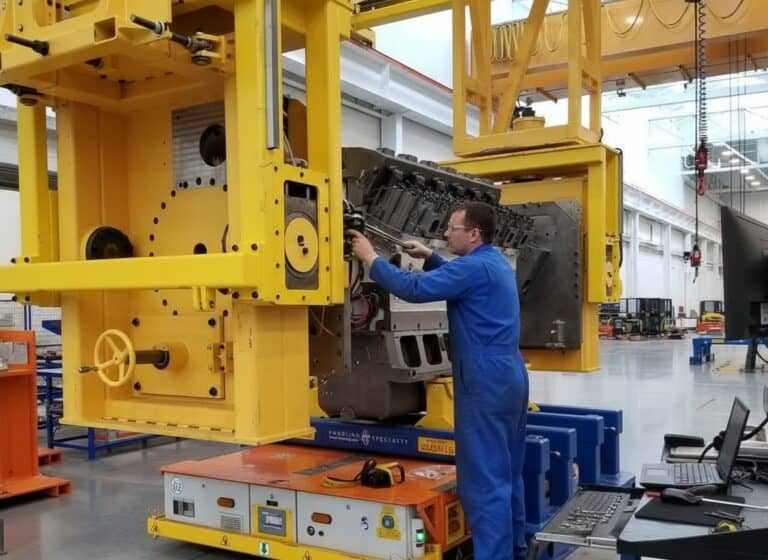
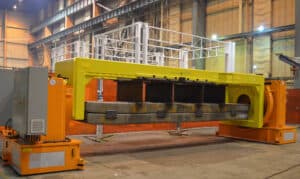
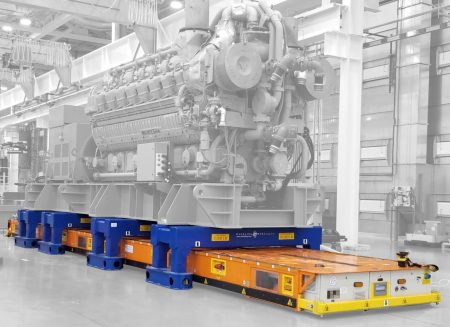
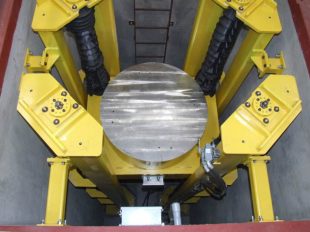
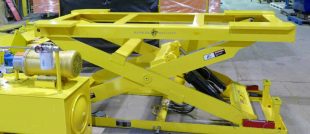
Catalog equipment is designed for the statistical middle of the market. Heavy industry rarely sits there. A ladle transfer in a steel plant, a crusher liner change in a mine, a reactor vessel lift in a refinery — each imposes load paths, duty cycles, and clearance constraints that no standard product line anticipates. Global mining development is increasing demand for higher-capacity fleets with automation and alternative-power capability, and that demand profile pushes directly past what off-the-shelf configurations can deliver. When the lift is one of a kind, the machine has to be as well.
Custom engineering in material handling equipment absorbs the energy transition more gracefully than fixed-specification equipment. Battery-electric and fuel cell drive packages change weight distribution, thermal management, and duty-cycle behavior. Designing the structure around a swappable power module rather than retrofitting one into a frame conceived for a diesel engine preserves the asset’s useful life across a regulatory shift that is already underway.
The cranes and lifting equipment segment of the material handling market was valued at USD 17.32 billion in 2024 which is a scale that reflects how much of industrial production depends on moving mass that no human workforce can move alone.

The Regulatory Horizon: Carbon, AI, and Data Privacy
Three regulatory pressures will shape heavy equipment specifications before the end of this decade, and each one carries design implications that can’t be retrofitted cheaply.
Carbon and emissions. Indoor air quality rules and corporate decarbonization commitments are pushing internal combustion out of enclosed material handling environments. Lithium-ion and hydrogen fuel cell drivetrains change charging infrastructure, floor loading, ventilation, and fire protection requirements. Equipment specified today without a defined migration path to electrified power like AGVs becomes a stranded asset when the mandate arrives.
Cyber-physical exposure. A connected crane, conveyor, or autonomous vehicle is an industrial control system with a network interface. Ransomware that once locked spreadsheets can now stop a production line or disable a safety interlock. Network segmentation, authenticated commands, and local fail-safe behavior that survives loss of connectivity are no longer IT concerns, but engineering requirements written into the control specification.
Data governance and interoperability. Operational telemetry increasingly crosses jurisdictional boundaries through vendor cloud platforms. Open standards and API-first control architectures let operators keep data residency under their own governance, audit what leaves the site, and replace a software layer without replacing the machine underneath it. Most OEMs will offer the ability to add IIoT into their custom material handling equipment.
Human-Machine Symbiosis: Redefining the Workforce
Automation in heavy handling environments redistributes labour instead of eliminating it. The roles that disappear are the repetitive, high-exposure ones which cause wear and tear on the body; the roles that emerge require more training, not less.
| Old Role | New Role | Required Skill |
| Manual picker | Automation technician | Mechatronics troubleshooting, sensor calibration |
| Forklift operator | Fleet supervisor | Traffic orchestration, exception dispatch |
| Rigger | Lift planning specialist | Load modeling, digital rigging plans |
| Maintenance mechanic | Reliability analyst | Condition monitoring, predictive diagnostics |
| Line supervisor | Systems integrator | Controls logic, data flow between platforms |
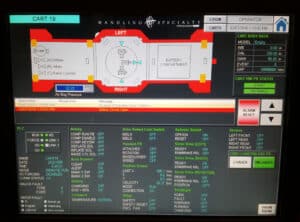
Human-in-the-loop design isn’t a transitional compromise on the way to full autonomy. In environments with irregular material, degraded visibility, or non-repeating lift geometry, the exception rate stays high enough that a supervisory operator is the system’s reliability mechanism. The machine handles mass and repetition; the person handles judgment and recovery. Designing the interface for that handoff, a clear status indication, unambiguous manual override, predictable fallback behavior, determines whether the system degrades safely or dangerously.
Training deserves the same treatment as equipment maintenance; it should be scheduled, documented, and budgeted. Material handling safety requirements assume competent operators, and competence in a hybrid environment now spans mechanical, electrical, and software domains that few incumbent workers were originally hired for.
Key Takeaways for Future-Proofing Operations
Resilience is an architectural property, not a feature set. It comes from decisions made at specification time about modularity, capacity headroom, and control openness. Decisions that cost little upfront and become prohibitively expensive to reverse once steel is in the ground. Understanding why material handling is important starts here: it’s the layer where every production decision eventually becomes a physical movement, and where failure propagates fastest.
- Specify modular, API-first control architectures. Proprietary, closed control stacks create vendor lock-in that outlasts the software company itself. Open interfaces let the digital layer evolve independently of the mechanical layer.
- Buy capacity headroom deliberately. Equipment sized precisely to today’s peak load has no tolerance for product changes, throughput growth, or heavier raw material. Headroom is cheaper than replacement.
- Treat connected equipment as an attack surface. Any machine with a network interface needs segmentation, authenticated commands, and defined fail-safe behavior when connectivity is lost.
- Design the power path for substitution. Structures built around swappable drive modules survive the shift from combustion to electrified power without full asset replacement.
- Measure resilience, not just throughput. Any OEM will tell you that mean time to recovery, single-point-of-failure count, and exception handling capacity predict long-term performance better than cycle time alone.
Building Your Future-State Roadmap
Start with a fragility audit rather than a technology shortlist. Walk the material flow and identify every point where a single machine, a single operator skill set, or a single software vendor can halt production. Those nodes are where capital earns its highest return, and they’re rarely the same places where efficiency consultants recommend spending. A conveyor transfer point that stops the plant matters more than a picking cell that runs three percent below target.
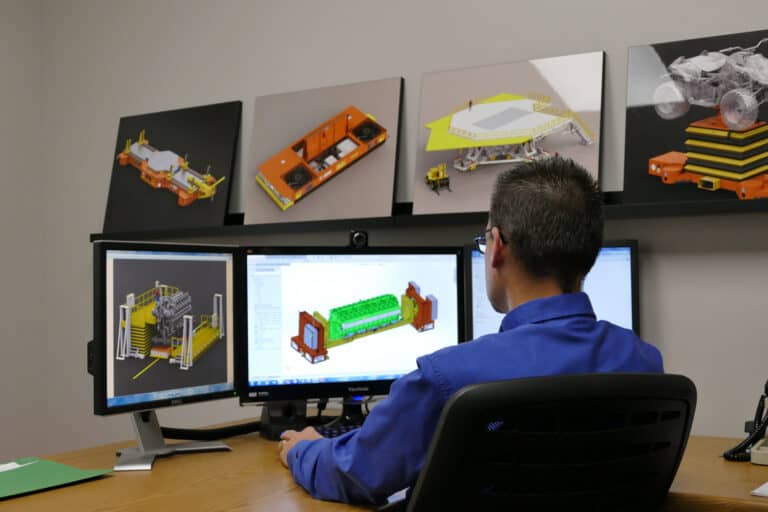
From there, the specification work gets harder, not easier. The future of material management in heavy industry depends on hardware engineered for conditions that catalog products weren’t designed to survive like abrasive media, extreme thermal cycling, non-repeating lift geometry, and loads measured in tons rather than pounds. Those applications require engineers who work in one-off design rather than configurators, and who can model duty cycles against a thirty-year asset life instead of a warranty period.
Organizations facing a handling challenge with no standard solution should bring engineering partners into the conversation before the budget is fixed, not after. The future belongs to operations that build for physical durability and adapt through digital intelligence — in that order.
Handling Specialty Manufacturing Ltd. has been design/building custom material handling equipment across multiple industries for over 60 years and is the perfect OEM to discuss your bespoke heavy-duty material handling needs with.