Lean Manufacturing Principles in Material Handling: A Guide to Reducing Waste
When parts sit idle, inventory bloats, or operators spend their shifts searching for components, the entire production process suffers. To thrive in a competitive market, manufacturers must shift their perspective: material handling is not merely a logistics function; it is a primary determinant of operational efficiency, safety, and bottom-line profitability. By applying Lean Manufacturing principles, organizations can transform their shop floor into a streamlined, responsive, and high-performing environment.
The Hidden Cost of Movement
Defining Material Handling within the Toyota Production System (TPS)
At the heart of Production System lies the realization that movement of materials, information, or people must add value. In traditional settings, material handling is viewed as the physical task of moving parts from receiving to production. Under Lean principles, however, it is redefined as the systematic management of flow. Production emphasizes that material handling should be invisible; it should support the operator without creating unnecessary work. When implemented correctly, these processes align with Just-In-Time (JIT) objectives, ensuring the right parts reach the right station at exactly the right time.
The “Transport” Trap: How Inefficient Movement Erodes Profit Margins
Transport is one of the classic “wastes” in manufacturing. Every time a component is lifted, placed, or moved, the cost of the finished product increases without adding any intrinsic value. Excessive movement creates bottlenecks, increases the risk of damage, and complicates tracking. Many firms accept this as a necessary evil, but Lean thinking identifies it as a direct erosion of profit margins. By reducing the distance and frequency of transport, manufacturers reclaim lost time, reduce energy consumption, and simplify production processes.
Identifying the 7 Wastes (Muda) in Material Handling
The Three Ms of Lean: Identifying and eliminating Muda (Waste), Mura (Unevenness), and Muri (Overburden) is essential for optimizing material handling.
Muda (Waste): Eliminating Non-Value-Added Activities in the Warehouse
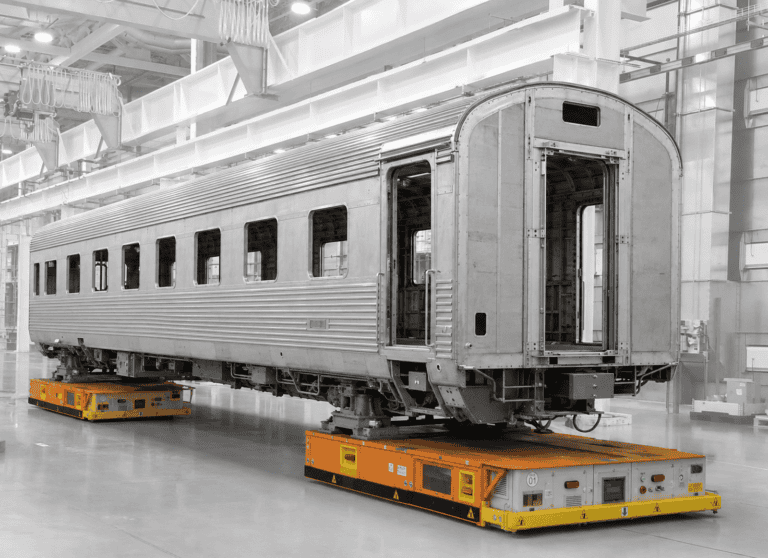
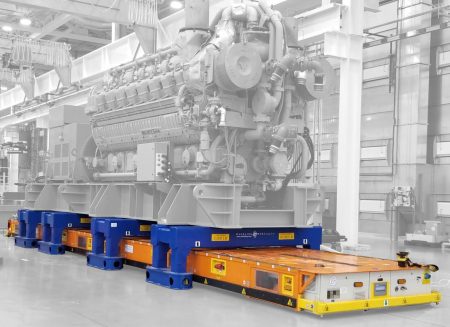
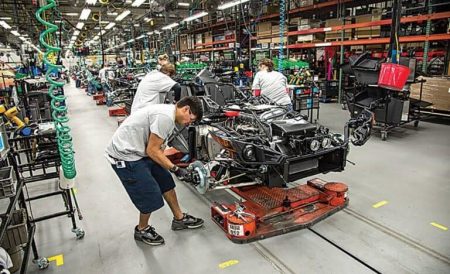
Muda represents the most recognizable form of waste: the non-value-added steps in material handling. This includes excessive travel distances between storage and production, waiting for material deliveries, or performing redundant quality checks during transport. By strictly identifying these tasks, managers can reorganize assembly and manufacturing layouts to eliminate unnecessary motion, ensuring that every movement is intentional and efficient. AGVs (Automated Guided Vehicles) lend themselves to this concept.
Mura (Unevenness): Smoothing Out Erratic Material Flows
Mura is the hidden killer of productivity. When production schedules fluctuate wildly, the material handling system experiences “peaks and valleys” of demand. This unevenness forces managers to stockpile inventory to buffer against shortages, leading to bloated inventory levels. Smoothing the flow requires a commitment to predictable, standardized work patterns that prevent the chaos of emergency, last-minute logistics.
Muri (Overburden): Preventing Strain on Equipment and Employees
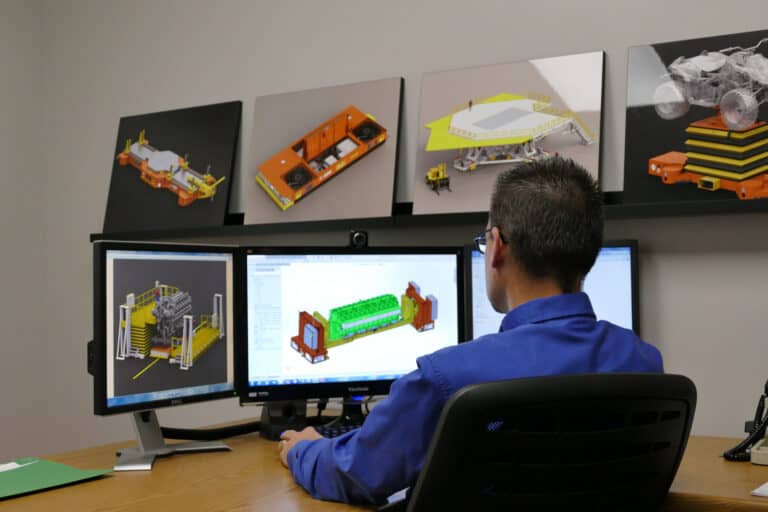
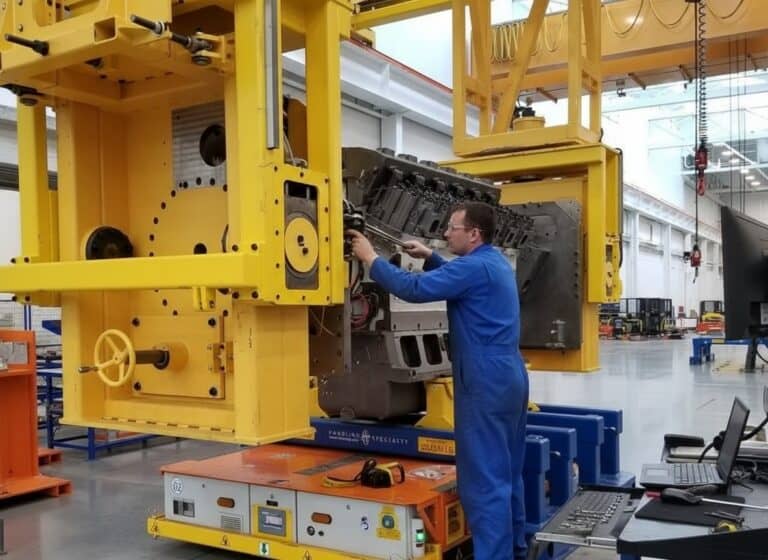
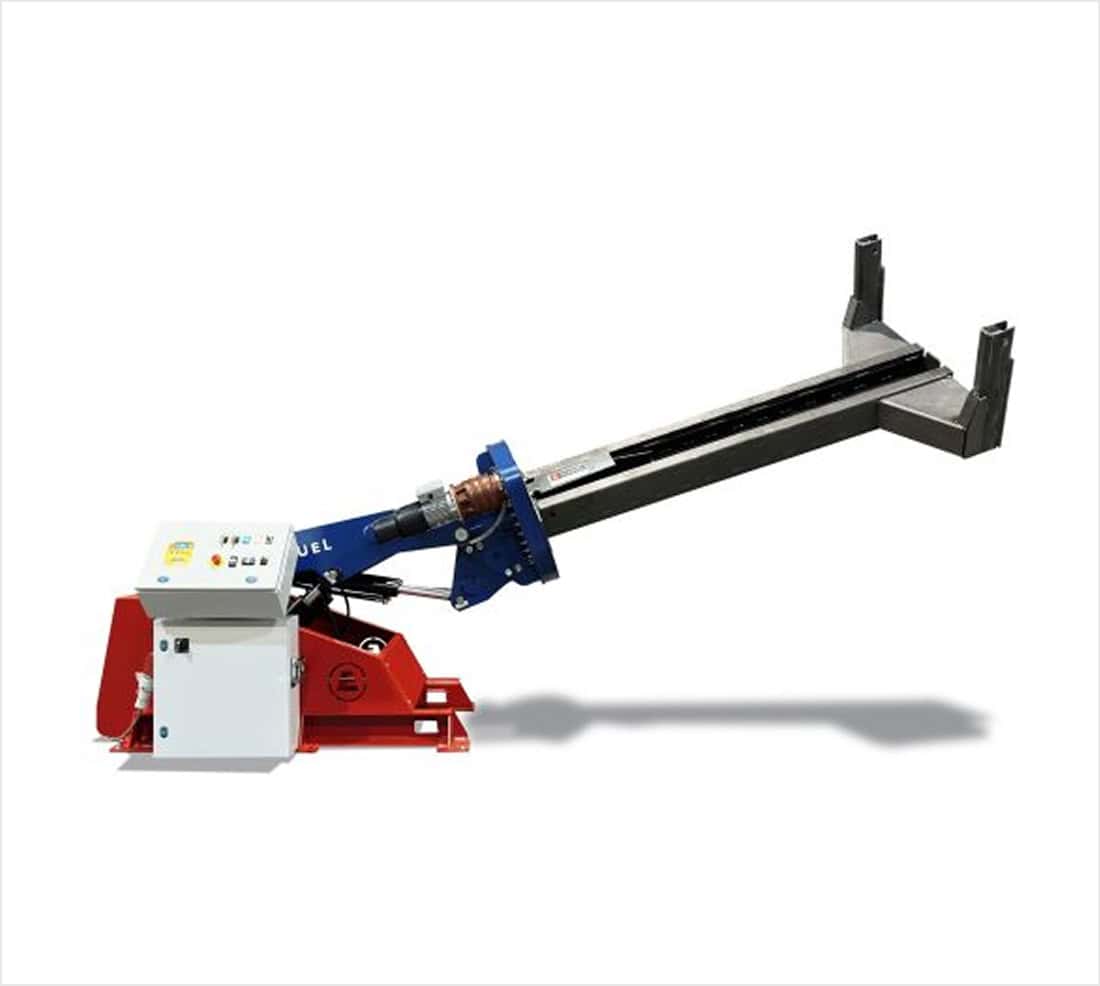
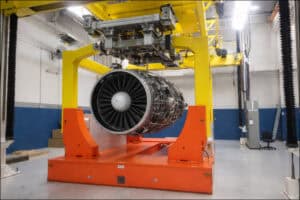
Muri refers to pushing systems and people beyond their natural limits. In material handling, this often manifests as rushing employees to meet impossible deadlines or forcing forklifts to operate at maximum capacity in cluttered aisles. This creates safety risks and accelerates equipment degradation. A truly Lean facility focuses on sustainable work cycles that protect the operator while maintaining consistent throughput. Again, AGVs with specialized tooling that assist technicians or robots in the assembly and manufacturing of products improves efficiency and safety.
Mapping the Internal Supply Chain with Value Stream Mapping (VSM)
Tracing the Journey of a Single Part: From Receiving to Shipping
Value Stream Mapping (VSM) provides a holistic view of the material journey. By tracing a single part from the moment it enters the receiving dock until it leaves as a finished product, teams can visualize the entire process. This exercise often reveals that a part spends 90% of its time sitting in storage or queue, which is a significant opportunity for improvement.
Identifying Bottlenecks and Excessive Travel Distances
When the VSM is complete, the physical evidence of inefficiency becomes clear. Are operators walking too far? Are raw materials stored in the wrong quadrant? VSM forces leaders to confront these geographic realities, providing the data necessary to justify layout changes or process re-engineering.
Visualizing Information Flow vs. Physical Material Flow
A critical, often overlooked aspect of VSM is the synchronization of information and materials. If the material moves, but the system records are updated hours later, the facility is essentially operating in the dark. Lean success depends on real-time visibility, ensuring that every physical move is triggered by an accurate information signal. Automated Guided Vehicles in manufacturing can work directly with operations by delivering real-time data so improvements can be made.
Essential Lean Tactics for Optimized Material Flow
Kanban Systems for Material Replenishment
The Kanban system is the hallmark of pull-based manufacturing. Rather than pushing parts onto the floor regardless of need, Kanban uses visual signals (cards, bins, or electronic alerts) to trigger replenishment only when parts are consumed. This keeps inventory levels lean and forces the production team to address process instability immediately.
Fixed-Quantity vs. Fixed-Time Conveyance Strategies
Depending on product variety and demand, firms may use either fixed-quantity or fixed-time conveyance. Fixed-quantity systems ensure replenishment occurs exactly when a threshold is hit, ideal for high-volume parts. Fixed-time systems (or “milk runs”) are better for consolidated, lower-volume items, reducing total traffic by aggregating multiple material drops into a single circuit.
The Role of the “Water Spider” (Mizusumashi) in Lean Logistics
The “Water Spider” is an operator tasked with keeping stations supplied so that production workers never have to leave their assigned cells. By centralizing the retrieval of materials, the Water Spider protects the value-added work of the production team, allowing them to maintain rhythm and flow without interruption.
Utilizing Heijunka Boxes for Production Leveling
Heijunka boxes help manufacturers level production volume and mix. By spreading out the work over a defined period, the material handling team avoids the “bullwhip effect,” where small changes at the shipping dock cause massive instability in the warehouse.
Creating a Self-Explaining Facility through Visual Management
5S Implementation on the Shop Floor
5S (Sort, Set in Order, Shine, Standardize, Sustain) is the foundational layer of visual management. A clean, organized assembly or manufacturing facility where everything has a labeled home allows employees to detect abnormalities instantly. If a bin is empty or a shelf is cluttered, the visual system alerts the team before production stops. This minimizes downtime.
Using Signs, Labels, and Floor Markings to Direct Traffic
A self-explaining facility leaves no room for ambiguity. Floor markings should delineate “work zones” from “transit lanes,” preventing collisions and keeping traffic moving efficiently. When storage locations are clearly marked with part numbers and capacities, human error is minimized.
Pick-to-Light and Visual Cues for Error-Proofing (Poka-Yoke)
Poka-Yoke, or error-proofing, involves creating mechanisms that prevent mistakes from happening. Pick-to-light systems guide operators to the exact location of the required part, ensuring they do not pick the wrong item. These visual cues replace reliance on memory with a bulletproof physical process.
Optimizing Storage and Layout for Maximum Space Utilization
Transitioning to a Cellular Layout to Minimize Material Travel
Transitioning from traditional functional departments to product-specific cells radically reduces the distance materials must travel. By placing necessary equipment and parts in close proximity, the facility becomes more flexible, reducing throughput time and labor costs.
Implementing FIFO (First-In, First-Out) Storage Systems
FIFO ensures that the oldest inventory is used first, preventing stagnation and degradation. Gravity-fed flow racks are a simple yet highly effective way to enforce FIFO, as parts are loaded from the back and retrieved from the front, naturally cycling through the system.
Strategies for Handling Low-Rotation Parts and Spare Parts Inventory
Not all items move at the same velocity. High-rotation parts should be staged in the “golden zone”—within easy reach of the assembly line. Low-rotation parts, however, should be stored in denser, less accessible locations to maximize space for the parts that keep the line running.
Tech-Enabled Lean: Integrating Automation into the Flow
When to Automate: Assessing Life-Cycle Costs vs. Manual Labor
Automation should never be used to mask bad processes. First, standardize and simplify the process; only then, automate your manufacturing. The decision to invest in technology should be based on long-term ROI and whether the solution increases the “flow” of value, rather than simply replacing a human with a machine.
Automated Guided Vehicles (AGVs)
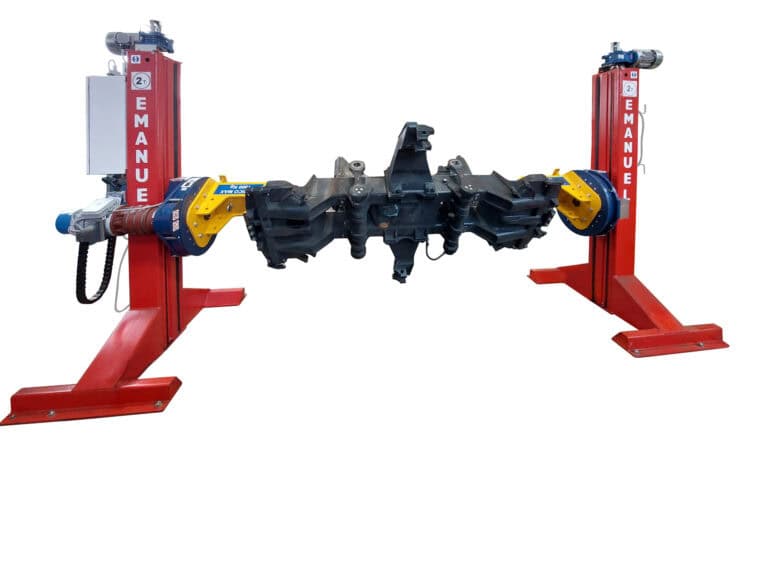
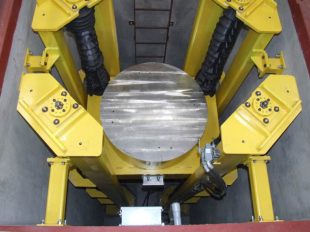
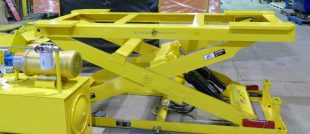
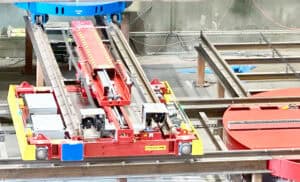
AGVs are excellent for repetitive, predictable transit routes. They remove the variance of human operators, ensuring that materials arrive at a steady, fixed pace. AGVs can also be fitted with bespoke tooling offering multiple options for precise positioning in a single work cell.
IoT Devices and Machine Monitoring: Real-Time Data Collection for Continuous Improvement
IoT sensors embedded in racks and transport equipment allow for real-time tracking of material status. This data is the lifeblood of continuous improvement, as it reveals the actual time taken for each movement versus the standard, allowing for data-driven adjustments.
Warehouse Management Systems (WMS) and Cloud-Based Visualizations
A robust WMS acts as the digital nervous system of the material handling process. By leveraging cloud-based platforms, managers can monitor inventory levels and flow patterns from anywhere, ensuring that strategic decisions are based on accurate, up-to-the-minute data.
Conclusion
Lean manufacturing in material handling is not merely about trimming costs; it is about building a resilient, responsive system that empowers employees and satisfies customers. By focusing on the “Three Ms”—Muda, Mura, and Muri—organizations can move beyond tactical fixes and toward a culture of continuous improvement.
Integrating Lean principles requires shifting from a mindset of “moving things” to “facilitating value.” Start by mapping your current processes to uncover hidden bottlenecks. Implement pull systems like Kanban to control inventory levels, and deploy visual management to make the floor self-explanatory. As you transition to more sophisticated layouts and select the right manufacturing automation tools, keep the human element at the center of the strategy. A truly effective material handling system respects the operator’s time, eliminates unnecessary physical exertion, and ensures that every motion adds to the quality and efficiency of the final product. By treating the shop floor as a dynamic, synchronized ecosystem rather than a collection of isolated tasks, you transform material handling into a sustainable competitive advantage that can withstand even the most volatile global supply chain conditions. Start today by choosing one process to optimize, and use the Kaizen spirit to iterate and improve until your flow is truly balanced.