Tandem AGV Systems in Modern Rail Car Assembly
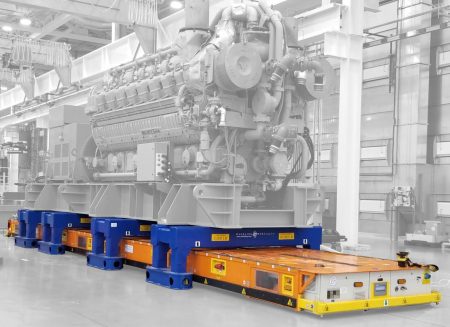
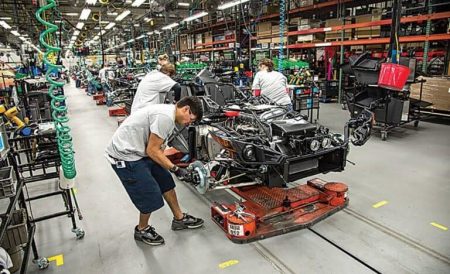
Fixed infrastructure is the silent productivity killer in modern rail car manufacturing. Synchronized tandem AGV systems are displacing fixed rails precisely because rigid, track-bound assembly environments can’t keep pace with the variability of today’s rolling stock production.
Fixed-line limitations compound quickly across a facility. Standard rail-mounted setups lock manufacturers into predetermined spacing and movement paths, making it nearly impossible to accommodate the varying lengths of different car body types on the same line. Overhead cranes introduce their own complications — safety exclusion zones, infrastructure load limits, and scheduling bottlenecks that stall throughput whenever a lift is in progress.
The challenge intensifies as rolling stock grows more complex. Bi-level passenger cars, articulated units, and extended freight configurations demand handling solutions that can adapt in real time, not ones anchored to a floor plan designed a decade ago. As Handling Specialty Manufacturing notes, integrating AGV transporters into existing production lines means “the traditionally fixed assembly line” can become “mobile and flexible” — a fundamental shift in how manufacturers think about throughput. Rigid thinking about infrastructure is, in practice, the primary barrier to achieving continuous 24/7 production cycles.
What’s driving the transition isn’t just flexibility — it’s also precision. The next section examines how Leader/Follower communication between paired AGVs enables two independent vehicles to operate as a single synchronized unit, solving the specific challenge of transporting ultra-long car bodies without compromising structural integrity.
Leader/Follower Synchronization for Ultra-Long Loads
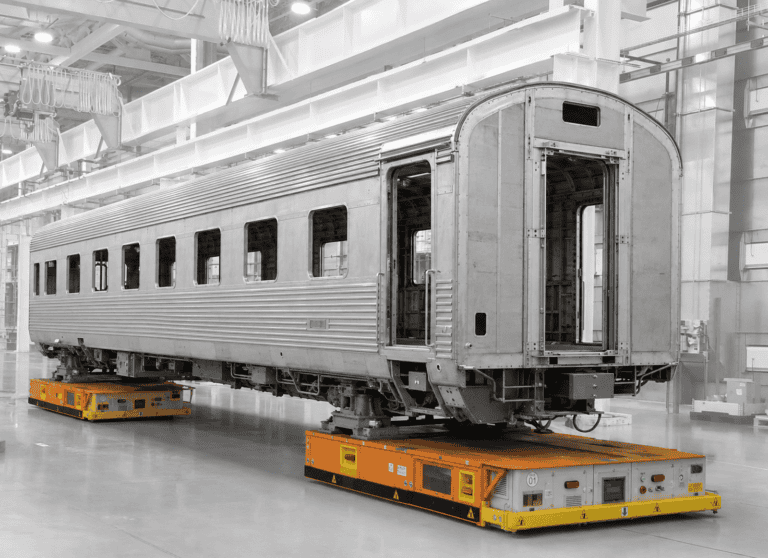
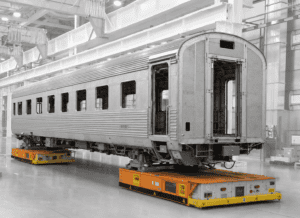
Outdoor rail car body handling demands a level of mechanical coordination that a single oversized transporter simply can’t deliver reliably at scale. When a car body stretches beyond 80 feet, distributing that load across two AGVs—locked together through a Leader/Follower communication architecture—transforms two independent machines into one precisely controlled unit.
The leader/follower model is what makes tandem AGV transport structurally viable for rail car bodies. The lead AGV continuously broadcasts position, speed, and directional data to the follower unit, synchronizing movement in real time. Any deviation in speed or heading triggers an immediate correction. The result is load distribution that stays balanced across both vehicles throughout the entire transfer cycle.
Synchronized tandem pairs outperform single oversized transporters in several key areas:
- Load stability: Distributed support eliminates stress concentration at any single point on the car body frame
- Omnidirectional movement: Independent wheel steering on each AGV allows both units to navigate tight rail yard corners without repositioning
- Scalability: Tandem pairs can be reconfigured for different body lengths without retooling fixed infrastructure
- Transfer speed: Synchronized dual-AGV systems can shorten material transfer times by up to 40% compared to traditional methods
Visually, picture the Leader AGV setting the movement vector while the follower mirrors that vector with a calculated offset—like two hands carrying a long beam, each one responding to the other’s micro-adjustments without any human input. That closed-loop feedback keeps the car body’s structural integrity intact through acceleration, cornering, and deceleration phases.
The omnidirectional capability deserves particular attention. Rail yards aren’t clean, linear environments. They involve angled approaches, constrained lane widths, and surface transitions—conditions that would force a rigid single transporter to stop, reposition, or slow to a crawl. Tandem AGVs with independent steering geometry handle those transitions smoothly, which is where much of that efficiency gain comes from. That same capability raises a new question, though: how does a system maintain centimeter-level precision once it moves from a structured indoor facility into an open outdoor yard?
Solving the Outdoor Navigation Challenge
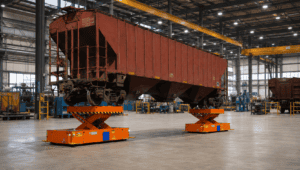
Outdoor rail yards strip away every navigational crutch that standard AGV systems depend on — and a heavy duty AGV for rail industry applications has to perform reliably without them.
Standard LiDAR struggles in open environments because it relies on fixed reference points — walls, columns, racking — to build a coherent map. In an open yard, those anchors simply don’t exist. Wind-blown debris, rain, and shifting light conditions compound the problem, leaving a LiDAR-only system without a stable positional frame. That’s where RTK-GPS takes over.
RTK-GPS (Real-Time Kinematic GPS) delivers centimeter-level positioning accuracy outdoors by calculating corrections against a fixed base station in real time. For a rail car body spanning 60+ feet and carried across two synchronized AGVs, that precision isn’t a luxury — it’s the margin between a clean transfer and a costly alignment error. According to Movanis, hybrid navigation combining RTK-GPS and LiDAR allows AGVs to maintain centimeter-level precision when transitioning between indoor assembly halls and outdoor rail yards — a capability that makes seamless handoffs between environments genuinely practical.
Additionally, any Automated Guided Vehicle can be turned into a Manually Guided Vehicle simply by adding a handheld pendant for an operator to control the units in difficult situations.
Weatherproofing and traction round out the outdoor readiness picture. Industrial-grade AGVs built for rail yard use typically carry IP65 or higher enclosure ratings, protecting drive electronics against rain and dust. Traction control algorithms actively adjust torque distribution when loads shift on wet asphalt or uneven concrete — preventing the micro-slippage that throws synchronization out of tolerance.
That combination of precise navigation and environmental resilience is what makes outdoor deployment viable. And once the hardware case is clear, the business case becomes equally compelling — which is exactly what the numbers around ROI start to reveal.
The ROI of Automated Rail Yard Logistics
Railway rolling stock AGV systems deliver a measurable return — not just in throughput, but across labor, asset protection, and workforce sustainability.
The production numbers alone make a compelling case. Heavy-duty AGV deployments in rail and automotive body handling have increased daily production output by 33%. In a rail yard environment where each car body represents significant capital investment, that kind of throughput gain compounds quickly across a production calendar.
Labor cost reduction is where the savings become concrete. Manual shunting and spotting operations require skilled spotters, signal operators, and ground crews working in coordinated shifts — often around the clock. Transitioning those tasks to synchronized AGV systems doesn’t eliminate headcount entirely, but it dramatically reduces the ratio of workers to units moved. The remaining personnel shift into supervisory and maintenance roles, which carry lower operational risk and often better retention rates.
Precision movement also protects the rolling stock itself. A misaligned manual spot or an uncontrolled shunt can cause thousands of dollars in damage to a single car body. AGV systems execute repeatable, controlled transfers that reduce those contact incidents significantly.
And then there’s the AGV operator labor shortage — a real pressure point in heavy industry right now. Automation doesn’t just offset that shortage; it restructures the dependency. Fewer specialized operators are needed to manage larger volumes, which makes operations more resilient to workforce fluctuations.
That resilience becomes especially important when you’re handling complex rolling stock configurations — like bi-level car bodies — where the stakes on every transfer are even higher.
Application Spotlight: Handling Bi-Level and Heavy Rolling Stock
Bi-level passenger car bodies present some of the most demanding weight distribution challenges in rail manufacturing — and standard transport solutions simply aren’t built for them.
Bi-level designs carry asymmetric mass across extended frame lengths, which means a single-point lift or a rigid rail system creates dangerous stress concentrations. Cars like multi-deck intercity coaches require support at precisely calculated intervals along the underframe, or you risk permanent structural deformation before the car ever reaches final assembly. Tandem AGV configurations answer this directly by distributing the load across multiple synchronized units, each responding to the same positioning commands in real time.
The integration of loading AGV workflows with lifting jacks and turntables adds another layer of complexity. In practice, the AGV doesn’t just transport — it coordinates with fixed infrastructure at each station, lowering or raising the car body to interface with jacks, rotating platforms, and tooling fixtures without human intervention. Synchronized modular transporters have demonstrated exactly this capability in heavy rail contexts, managing multi-axis positioning for loads that would overwhelm conventional handling equipment.
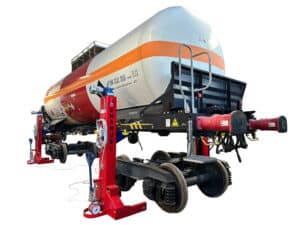
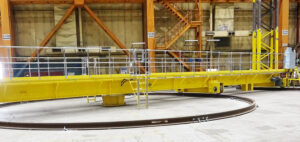
A self-propelled modular transporter architecture is what makes multi-stage assembly genuinely flexible. Rather than committing to a fixed path, these units can reconfigure between assembly stations as the production sequence demands.
Summary: The Future of Rail Manufacturing
Tandem-synchronized AGVs aren’t just an incremental upgrade — they represent a fundamental rethinking of how rail car bodies move through production.
- Tandem synchronization removes the infrastructure ceiling. Ultra-long rail car bodies — including bi-level passenger cars — require precise, coordinated lift across multiple points. Rigid fixed-rail systems can’t always adapt to that; synchronized AGV pairs can. This single capability unlocks handling flexibility that fixed infrastructure simply can’t match.
- Hybrid navigation is non-negotiable for real-world facilities. Outdoor yards and indoor assembly bays present completely different environmental conditions. A navigation stack that combines RTK-GPS for open-air positioning with LiDAR for indoor obstacle detection ensures operational continuity without a handoff gap. One system, no dead zones.
- The throughput gains are documented. Automated AGV systems deliver a proven 33% boost in production throughput — a figure that compounds over time as facilities scale output without proportional labor increases.
- Assembly line flexibility is the only durable competitive advantage. Rail car designs will keep evolving — longer bodies, new configurations, shifting weight distributions. A reconfigurable AGV-based system absorbs those changes. A fixed-rail installation doesn’t.
The manufacturers that invest in flexible, automated handling today are building production capacity that won’t be obsolete when the next generation of rolling stock arrives. The real question isn’t whether to transition, but rather, it’s how to engineer that transition for your specific yard layout and operational demands.
Engineering Your Transition to Automated Handling
Transitioning to synchronized tandem AGVs is a disciplined engineering process, one that starts with an honest assessment of your existing yard and ends with a fully optimized system built for the long term.
The first step is evaluating your yard for AGV compatibility. Surface conditions, grade tolerances, turning radii, and load transfer zones all influence system design before a single unit is specified. Outdoor rail yards introduce variables like freeze-thaw cycles, debris accumulation, uneven concrete that a standard warehouse AGV study simply won’t capture.
Custom-engineered solutions consistently outperform off-the-shelf transporters in heavy rail applications. Generic platforms aren’t designed to handle the asymmetric load profiles of bi-level car bodies or the precise synchronization tolerances that multi-unit tandem configurations demand. When payload weights exceed 100 tons and dimensional tolerances are tight, a purpose-built system isn’t a premium — it’s a requirement.
That’s where Handling Specialty’s expertise becomes a decisive advantage. With deep experience designing heavy-duty material handling systems for harsh environments including extreme cold, outdoor exposure, and high-cycle industrial conditions, Handling engineers solutions that account for your specific fleet, facility, and throughput targets from day one.
The path forward is straightforward. Engage our engineering team for a consultation, map your current process against the performance benchmarks a tandem automated guided vehicle system can achieve, and define a phased installation plan that minimizes production disruption. The shift away from fixed rails is already underway across the industry — and the right engineering partner makes that transition both predictable and permanent. Contact Handling Specialty to begin your engineering consultation today.